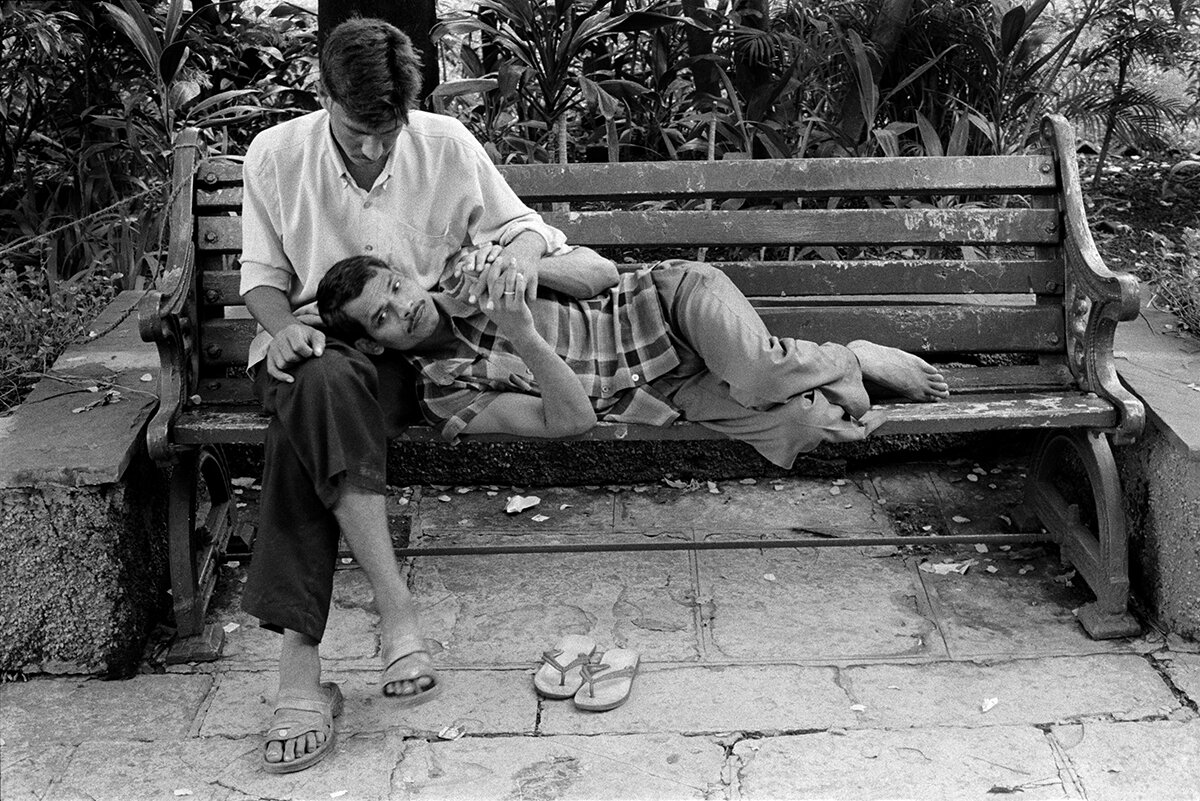
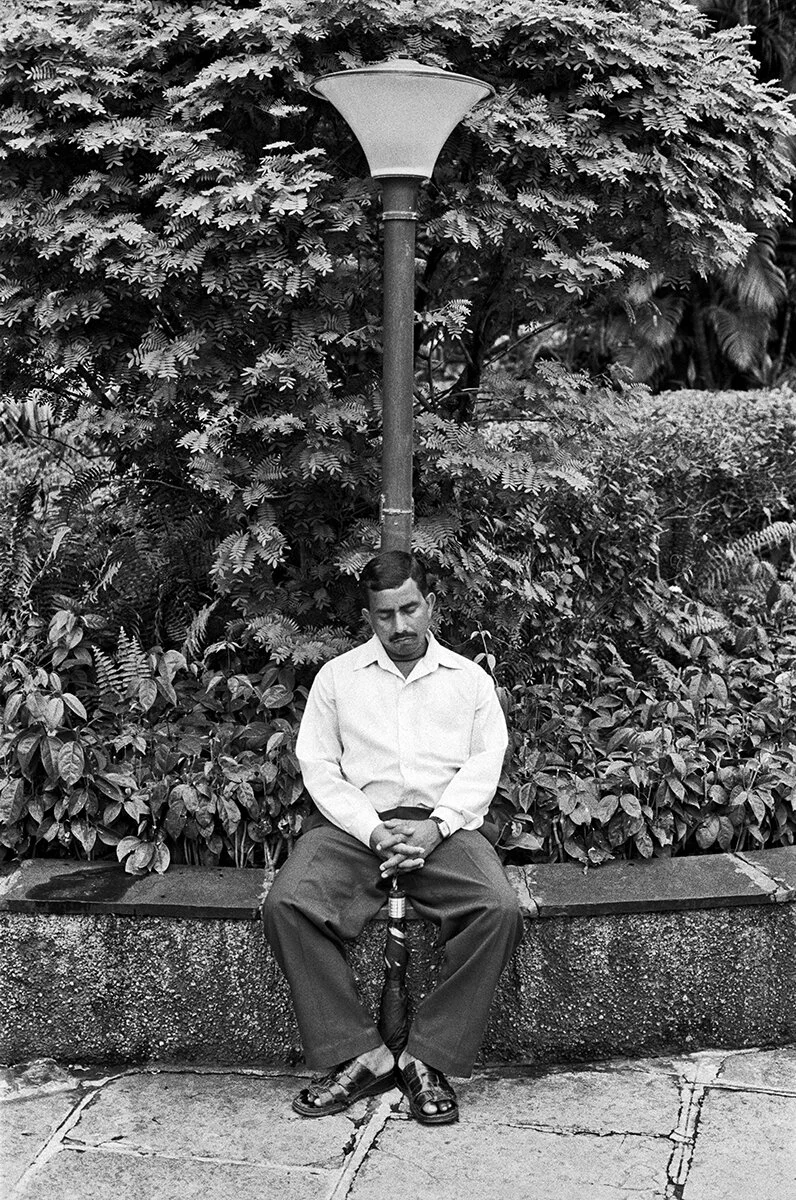
Man-City-Garden: Portrait of Horniman Circle Garden
I cannot remember the first time I visited Horniman Circle Garden. Since it is in the heart of the commercial and heritage district called ‘The Fort’, it is a garden through which one passes. One does not stop, not if one has work to do.
Then, one afternoon, several months ago, I stopped. I had no reason to stop other than the standard issue reasons of the city boy in the middle of a green space. I was taken by the greenery, by the odd melancholy of the metal sculpture in the centre of a dead fountain and by the silence.
The silence had a peculiar quality, a quality of waiting, a quality of suspension. It was as if everyone in the park had retreated into a quiet space. I didn’t think. I began to photograph the park. At that point, I told myself that it was my on-going commitment to street photography, my own fascination with the sudden dramas that are played out in busy causeways, the evanescence of these sudden encounters of body and architecture and light and colour.
But I returned to Horniman Circle Gardens, drawn by the nature of the park, the nature of its denizens and the quality of their interactions with their space. For many it seemed to be a place where they could relax, drop for a moment the accoutrements of modernity, return to a simpler, more basic connection with nature. It is generally men who come to this park, men who seem to be in the middle of a crisis.
Of course, one might argue that to live in a city is to be in the middle of a crisis at all times, but perhaps this is what fascinates me about Horniman Circle. The action is elsewhere. These are the wings. If all the world’s a stage and all the men and women actors, these are the bit players who have stepped from the arch of the proscenium into the darkness. Some of them need to sleep. Some need to recoup their losses. Some need to consider what the next step is. Some need to close the circle with the body.
For although we need our parks and our gardens, the middle and upper classes rarely use them if they are not taking their children out or if they are retired. To find yourself in a park in the middle of a working day, as a man, is not a good sign at all. To be in Horniman Circle, which does not even have the usual freight of screaming children or determined joggers and walkers burning fat, is to find yourself in a world that is in a state of limbo.
I see my Horniman Circle series as a way of interrogating city life. I see it as a way of examining what it means to us to be private in a public space. I see it as an investigation of how those who do not have a way of cutting off the world will use other devices, the turning of a body, the deployment of a newspaper, even just the closing of the eyes to cut off the world. I know that at some level, this is also about an intrusion. Many of my subjects are almost hostile. They know as I know that they are at a low ebb here. If they weren’t, they would find an air-conditioned bar with a television spraying them with meaningless images and the chatter of people and they would nurse their grievances against the world there.
In this series of images, I hope to investigate the relationship of man, city and garden. This is the Garden of Earthly Depressions, a liminal space in which people come to regroup. Like all liminal spaces, it allows for a change of identities. The man who takes off his shiny shoes and goes to sleep is not just taking a rest; he is taking a rest from the person he is when he wears those shoes and presents himself to the world as Homo economicus. The man who studies his finger-nails is allowing himself a break from looking outward, from manning his boundaries.
If the garden was once created as a space which approximated paradise, Horniman Circle is an approximation of the waiting room to limbo.